
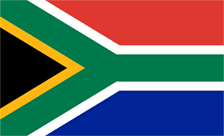
The Republic of South Africa (also known by other official names) is a country located at the southern tip of Africa . It borders the Atlantic and Indian oceans and Namibia, Botswana, Zimbabwe, Mozambique, Swaziland, and Lesotho, an independent enclave surrounded by South African territory. South Africa is a member of the Commonwealth of Nations. The South African economy is the largest in Africa and 24th largest in the world. Due to this it is the most socially, economically and infrastructurally developed country on the continent.
South Africa has experienced a different history from other nations in Africa because of early immigration from Europe and the strategic importance of the Cape Sea Route. European immigration began shortly after the Dutch East India Company founded a station at what would become Cape Town, in 1652. The closure of the Suez Canal during the Six-Day War highlighted its significance to East-West trade. The country's relatively developed infrastructure made its mineral wealth available and important to Western interests, particularly throughout the late nineteenth century and, with international competition and rivalry, during the Cold War. South Africa is ethnically diverse, with the largest Caucasian, Indian, and racially mixed communities in Africa. Black South Africans, who speak nine officially recognised languages, and many more dialects, account for nearly 80% of the population.
Racial strife between the white minority and the black majority has played a large part in South Africa's history and politics, culminating in apartheid, which was instituted in 1948 by the National Party (although segregation existed before that time). The laws that defined apartheid began to be repealed or abolished by the National Party in 1990, after a long and sometimes violent struggle, including economic sanctions from the international community.
Several philosophies and ideologies have developed in South Africa, including ubuntu (the belief in a universal bond of sharing that connects all humanity) and Jan Smuts's holism.
Regular elections have been held for almost a century; but the majority of South Africans were not enfranchised until 1994.
South Africa is often called the "Rainbow Nation", a term coined by Archbishop Desmond Tutu and later adopted by then President Nelson Mandela. Mandela used the term "Rainbow Nation" as a metaphor to describe the country's newly developing multicultural diversity after segregationist apartheid ideology. By 2007, the country had joined Belgium, the Netherlands, Canada, and Spain in legalizing same-sex marriage. South Africa is located at the southernmost region of Africa, with a long coastline that stretches more than 2,500 kilometres (1,550 mi) and across two oceans (the Atlantic and the Indian). At 470,979 sq mi (1,219,912 km²), South Africa is the world's 25th-largest country (after Mali). It is comparable in size to Colombia. Njesuthi in the Drakensberg at 3,408 m (11,424 ft) is the highest peak in South Africa.
South Africa has a generally temperate climate, due in part to it being surrounded by the Atlantic and Indian Oceans on three sides, by its location in the climatically milder southern hemisphere and due to the average elevation rising steadily towards the north (towards the equator) and further inland. Due to this varied topography and oceanic influence, a great variety of climatic zones exist.
The climatic zones vary, from the extreme desert of the southern Namib in the farthest northwest to the lush subtropical climate in the east along the Mozambique border and the Indian ocean. From the east, the land quickly rises over a mountainous escarpment towards the interior plateau known as the Highveld. Even though South Africa is classified as semi-arid, there is considerable variation in climate as well as topography.
The interior of South Africa is a vast, rather flat, and sparsely populated scrubland, Karoo, which is drier towards the northwest along the Namib desert. In contrast, the eastern coastline is lush and well-watered, which produces a climate similar to the tropics. The extreme southwest has a climate remarkably similar to that of the Mediterranean with wet winters and hot, dry summers, hosting the famous Fynbos Biome. This area also produces much of South Africa's wine. This region is also particularly known for its wind, which blows intermittently almost all year. The severity of this wind made passing around the Cape of Good Hope particularly treacherous for sailors, causing many shipwrecks. Further east on the country's south coast, rainfall is distributed more evenly throughout the year, producing a green landscape. This area is popularly known as the Garden Route.
The Free State is particularly flat due to the fact that it lies centrally on the high plateau. North of the Vaal River, the Highveld becomes better watered and does not experience subtropical extremes of heat. Johannesburg, in the centre of the Highveld, is at 1,740 metres (5,709 ft) and receives an annual rainfall of 760 millimetres (30 in). Winters in this region are cold, although snow is rare.
To the north of Johannesburg, the altitude drops beyond the Highveld's escarpment, and turns into the lower lying Bushveld, an area of mixed dry forest and an abundance of wildlife. East of the Highveld, beyond the eastern escarpment, the Lowveld stretches towards the Indian ocean. It has particularly high temperatures, and is also the location of extended subtropical agriculture. The mountains of the Barberton Greenstone belt in the lowveld are the oldest mountains on Earth, dating back 3.5 Billion years. The earliest reliable proof of life (dated 3.2–3.5 Billion years old) has been found in these mountains.
The high Drakensberg mountains, which form the south-eastern escarpment of the Highveld, offer limited skiing opportunities in winter.The coldest place in South Africa is Sutherland in the western Roggeveld Mountains, where midwinter temperatures can reach as low as -15 degrees Celsius (5 °F). The deep interior has the hottest temperatures: A temperature of 51.7 °C (125 °F) was recorded in 1948 in the Northern Cape Kalahari near Upington.
South Africa also has one possession, the small sub-Antarctic archipelago of the Prince Edward Islands, consisting of Marion Island (290 km²/112 sq mi) and Prince Edward Island (45 km²/17.3 sq mi) (not to be confused with the Canadian province of the same name). |