
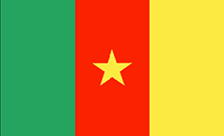
The Republic of Cameroon is a unitary republic of central and western Africa. It borders Nigeria to the west; Chad to the northeast; the Central African Republic to the east; and Equatorial Guinea, Gabon, and the Republic of the Congo to the south. Cameroon's coastline lies on the Bight of Bonny, part of the Gulf of Guinea and the Atlantic Ocean. The country is called "Africa in miniature" for its geological and cultural diversity. Natural features include beaches, deserts, mountains, rain forests, and savannas. The highest point is Mount Cameroon in the southwest, and the largest cities are Douala, Yaoundé, and Garoua. Cameroon is home to over 200 different ethnic and linguistic groups. The country is well known for its native styles of music, particularly makossa and bikutsi, and for its successful national football team. English and French are the official languages.
Early inhabitants of the territory included the Sao civilisation around Lake Chad and the Baka hunter-gatherers in the southeastern rainforest. Portuguese explorers reached the coast in the 15th century and named the area Rio dos Camarões ("River of Prawns"), the name from which Cameroon derives. Fulani soldiers founded the Adamawa Emirate in the north in the 19th century, and various ethnic groups of the west and northwest established powerful chiefdoms and fondoms. Cameroon became a German colony in 1884. After World War I, the territory was divided between France and Britain as League of Nations mandates. The Union des Populations du Cameroun political party advocated independence but was outlawed in the 1950s. It waged war on French and Cameroonian forces until 1971. In 1960, French Cameroun became independent as the Republic of Cameroun under President Ahmadou Ahidjo. The southern part of British Cameroons merged with it in 1961 to form the Federal Republic of Cameroon. The country was renamed the United Republic of Cameroon in 1972 and the Republic of Cameroon in 1984.
Compared with other African countries, Cameroon enjoys political and social stability. This has permitted the development of agriculture, roads, railways, and large petroleum and timber industries. Nevertheless, large numbers of Cameroonians live in poverty as subsistence farmers. Power lies firmly in the hands of the president, Paul Biya, and his Cameroon People's Democratic Movement party, and corruption is widespread. The Anglophone community has grown increasingly alienated from the government, and Anglophone politicians have called for greater decentralization and even the secession of the former British-governed territories. At 475,442 square kilometers (183,569 sq mi), Cameroon is the world's 53rd-largest country. It is comparable in size to Papua New Guinea and somewhat larger than the U.S. state of California. The country is located in Central and West Africa on the Bight of Bonny, part of the Gulf of Guinea and the Atlantic Ocean. Tourist literature describes Cameroon as "Africa in miniature" because it exhibits all major climates and vegetation of the continent: coast, desert, mountains, rain forest, and savanna. The country's neighbors are Nigeria to the west; Chad to the northeast; the Central African Republic to the east; and Equatorial Guinea, Gabon, and the Republic of the Congo to the south.
Cameroon is divided into five major geographic zones distinguished by dominant physical, climatic, and vegetative features. The coastal plain extends 15 to 150 kilometers (10 to 90 mi) inland from the Gulf of Guinea and has an average elevation of 90 meters (295 ft). Exceedingly hot and humid with a short dry season, this belt is densely forested and includes some of the wettest places on earth. The South Cameroon Plateau rises from the coastal plain to an average elevation of 650 meters (2,130 ft). Equatorial rain forest dominates this region, although its alternation between wet and dry seasons makes it is less humid than the coast.
An irregular chain of mountains, hills, and plateaus known as the Cameroon range extends from Mount Cameroon on the coast- Cameroon's highest point at 4,095 meters (13,435 ft)- almost to Lake Chad at Cameroon's northern tip. This region has a mild climate, particularly on the Western High Plateau, although rainfall is high. Its soils are among Cameroon's most fertile, especially around volcanic Mount Cameroon. Volcanism here has created crater lakes. On 21 August 1986, one of these, Lake Nyos, belched carbon dioxide and killed between 1,700 and 2,000 people.
The southern plateau rises northward to the grassy, rugged Adamawa Plateau. This feature stretches from the western mountain area and forms a barrier between the country's north and south. Its average elevation is 1,100 meters (3,600 ft), and its temperature ranges from 22 to 25 °C (72 to 77 °F) with high rainfall. The northern lowland region extends from the edge of the Adamawa to Lake Chad with an average elevation of 300 to 350 meters (980 to 1,150 ft). Its characteristic vegetation is savanna scrub and grass. This is an arid region with sparse rainfall and high median temperatures.
Cameroon has four patterns of drainage. In the south, the principal rivers are the Ntem, Nyong, Sanaga, and Wouri. These flow southwestward or westward directly into the Gulf of Guinea. The Dja and Kadéï drain southeastward into the Congo River. In northern Cameroon, the Bénoué River runs north and west and empties into the Niger. The Logone flows northward into Lake Chad, which Cameroon shares with three neighboring countries. |