
home

sitemap

contact us

faqs
International Domain Registration North American Domain Registration Central American Domain Registration South American Domain Registration African Domains Asia Domains European Domains Domain Registration Shopping Cart
 
Price and Requirements for .CO.NA Domain Registration
$ 899.00
Registration Fee - 1 year Registration Contract
Registration Time Frame: 1 to 2 Weeks
Registration reserved for commercial entities only.
Requirements
Included
Application Fee
.CO.NA Namibia Country Information

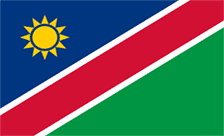
Namibia, officially the Republic of Namibia, is a country in southern Africa on the Atlantic coast. It shares borders with Angola and Zambia to the north, Botswana to the east, and South Africa to the south. It gained independence from South Africa in 1990 and its capital city is Windhoek. Namibia is a member state of the United Nations (UN), the Southern African Development Community (SADC), the African Union (AU), and the Commonwealth of Nations. It is named after the Namib Desert.


At 825,418 km² (318,696 mi²), Namibia is the world's thirty-fourth largest country (after Venezuela). After Mongolia, Namibia is the least densely populated country in the world (2.5 persons per km²).

The Namibian landscape consists generally of five geographical areas, each with characteristic abiotic conditions and vegetation with some variation within and overlap between them: the Central Plateau, the Namib Desert, the Escarpment, the Bushveld, and the Kalahari Desert. Although the climate is generally extremely dry, there are a few exceptions. The cold, north-flowing Benguela current accounts for some of the low precipitation.

The Central Plateau runs from north to south, bordered by the Skeleton Coast to the north west, the Namib Desert and its coastal plains to the south west, the Orange River to the south, and the Kalahari Desert to the east. The Central Plateau is home to the highest point in Namibia at Königstein elevation 2,606 metres (8,411 feet). Within the wide, flat Central Plateau is the majority of Namibia’s population and economic activity. Windhoek, the nation’s capital, is located here, as well as most of the arable land. Although arable land accounts for only 1% of Namibia, nearly half of the population is employed in agriculture.

The abiotic conditions here are similar to those found along the Escarpment, described below; however the topographic complexity is reduced. Summer temperatures in the area can reach 40°C during the summer, and in the winter, frosts are common.

The Namib Desert is a broad expanse of hyper-arid gravel plains and dunes that stretches along the entire coastline, which varies in width between 100 to many hundreds of kilometres. Areas within the Namib include the Skeleton Coast and the Kaokoveld in the north and the extensive Namib Sand Sea along the central coast. The sands that make up the sand sea are a consequence of erosional processes that take place within the Orange River valley and areas further to the south. As sand-laden waters drop their suspended loads into the Atlantic, onshore currents deposit them along the shore. The prevailing south west winds then pick up and redeposit the sand in the form of massive dunes in the widespread sand sea. In areas where the supply of sand is reduced because of the inability of the sand to cross riverbeds, the winds also scour the land to form large gravel plains. In many areas within the Namib Desert, there is little vegetation with the exception of lichens found in the gravel plains, and in dry river beds where plants can access subterranean water.

The Great Escarpment swiftly rises to over 2000 metres. Average temperatures and temperature ranges increase as you move further inland from the cold Atlantic waters, while the lingering coastal fogs slowly diminish. Although the area is rocky with poorly developed soils, it is nonetheless significantly more productive than the Namib Desert. As summer winds are forced over the Escarpment, moisture is extracted as precipitation. The water, along with rapidly changing topography, is responsible for the creation of microhabitats which offer a wide range of organisms, many of them endemic. Vegetation along the Escarpment varies in both form and density, with community structure ranging from dense woodlands to more shrubby areas with scattered trees. A number of Acacia species are found here, as well as grasses and other shrubby vegetation.

The Bushveld is found in north eastern Namibia along the Angolan border and in the Caprivi Strip which is the vestige of a narrow corridor demarcated for the German Empire to access the Zambezi River. The area receives a significantly greater amount of precipitation than the rest of the county, averaging around 400 millimetres per year. Temperatures are also cooler and more moderate, with approximate seasonal variations of between 10°C and 30°C. The area is generally flat and the soils sandy, limiting their ability to retain water. Located adjacent to the Bushveld in north-central Namibia is one of nature’s most spectacular features: the Etosha Pan. For most of the year it is a dry, saline wasteland, but during the wet season, it forms a shallow lake covering more than 6000 square kilometres. The area is ecologically important and vital to the huge numbers of birds and animals from the surrounding savannah that gather in the region as summer drought forces them to the scattered waterholes that ring the pan.

The Kalahari Desert is perhaps Namibia’s best known geographical feature. Shared with South Africa and Botswana, it has a variety of localized environments ranging from hyper-arid sandy desert, to areas that seem to defy the common definition of desert. One of these areas, known as the Succulent Karoo, is home to over 5,000 species of plants, nearly half of them endemic; fully one third of the world’s succulents are found in the Karoo.

The reason behind this high productivity and endemism may be the relatively stable nature of precipitation. The Karoo apparently does not experience drought on a regular basis, so even though the area is technically desert, regular winter rains provide enough moisture to support the region’s interesting plant community. Another feature of the Kalahari, indeed many parts of Namibia, are Inselbergs, isolated mountains that create microclimates and habitat for organisms not adapted to life in the surrounding desert matrix.

Besides the capital city Windhoek in the centre of the country, other important towns are the ports of Walvis Bay and Swakopmund, as well as Oshakati and Grootfontein.

.CO.NA Namibia Domain Name - Country Information
Country Domain
Country Information
TLD Information
 
 
WHOIS Server
Domain Name Renew
 
 
Namibia Domain Search Terms:
Namibia Domain Name Registration, .CO.NA Domain Revgistration, Namibia .CO.NA Domain, Domain Name .CO.NA, Register Chinese Domain, Chinese Domain Names
All Namibia Domain Extensions Available
Country Code Top Level Domain designated for Namibia
.na
Second Level Domains - SLD's
.com.na
Trademark Registration in Namibia
 
Namibia Trademark Comprehensive Study
 
Namibia Trademark Registration Request
 
Namibia Trademark Registration Certificate


  International Domain Registration North American Domain Registration Central American Domain Registration South American Domain Registration African Domains Asia Domains European Domains  

See All Africa Country Domain Information - Domain Registration for Africa
RWG DBA Rerun Domain - 101domain.comIana LogoAcepted Credit Cards101domain.com BBBOnLine Reliability Participation Confirmed For Rightway Gate Inc.
Rightway Gate Inc. DBA 101domain.com - Rerundomains.com, 5858 Edison Place Carlsbad, CA 92008
Phone: Toll Free US 1-888-398-4703, Phone: International ++1-760-736-3700, Fax: 1-760-736-3701
Copyright © 1993 - 2008 By Rightway Gate Inc. The Smart Business Online Contact, Last Updated:Thursday, November 13, 2008
Top Market Place Domains
[International Web Address Registration] [International Domain Names] [Domain Name Registration] [Domain Registration Global] [Worldwide Domain Registration]