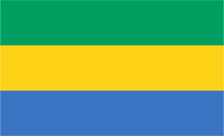
The Gabonese Republic, or Gabon is a country in west central Africa sharing borders with Equatorial Guinea, Cameroon, Republic of the Congo and the Gulf of Guinea. The capital and largest city is Libreville. Since its independence from France on August 17, 1960, the Republic has been ruled by only two autocratic presidents. In the early 1990s, Gabon introduced a multi party system and a new democratic constitution that allowed for a more transparent electoral process and reformed many governmental institutions. A small population (less than two million), abundant natural resources, and foreign private investment have helped make Gabon one of the most prosperous countries in the region, with the highest HDI in Sub-Saharan Africa. Gabon is located on the Atlantic coast of central Africa. Located on the equator, Gabon has an equatorial climate with an extensive system of rainforests covering 85% of the country. There are three distinct regions: the coastal plains (ranging between 20 to 300 km from the ocean's shore), the mountains (the Cristal Mountains to the northeast of Libreville, the Chaillu Massif in the centre, culminating at 1575 m with Mont Iboundji), and the savanna in the east. Gabon's largest river is the Ogooué which is 1200 km long. Gabon is also noted for efforts to preserve the natural environment. In 2002, President Omar Bongo Ondimba put Gabon firmly on the map as an important future ecotourism destination by nominating more than 11% of the nation's territory as National Park (13 in total), which may be the largest area of nature parks in the world. Natural resources include: petroleum, magnesium, iron, gold, uranium, and forests. |