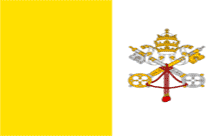
Vatican City, officially State of the Vatican City, is a landlocked sovereign city-state whose territory consists of a walled enclave within the city of Rome. At approximately 44 hectares (110 acres), and with a population of around 800, it is the smallest independent state in the world by both population and area.
The city-state came into existence by virtue of the Lateran Treaty in 1929, which spoke of it as a new creation (Preamble and Article III), not as a vestige of the much larger Papal States (756 to 1870) that had previously encompassed central Italy. Most of this territory was absorbed into the Kingdom of Italy in 1860, and the final portion, namely the city of Rome with a small area close to it, ten years later, in 1870.
Vatican City is a non-hereditary, elected monarchy that is ruled by the Bishop of Rome - the Pope. The highest state functionaries are all clergymen of the Catholic Church. It is the sovereign territory of the Holy See (Sancta Sedes) and the location of the Pope's residence, referred to as the Apostolic Palace.
The Popes have resided in the area that in 1929 became the Vatican City only since the return from Avignon in 1377. Previously, they resided in the Lateran Palace on the Caelian Hill on the opposite side of Rome, which was out of repair in 1377. The signing of the agreements that established the new state took place in the latter building, giving rise to the name of Lateran Pacts, by which they are known. The Vatican City, one of the European microstates, is situated on the Vatican Hill in the west-central part of Rome, several hundred metres west of the Tiber river. Its borders (3.2 km or 2 miles in total, all within Italy) closely follow the city wall constructed to protect the Pope from outside attack. The situation is more complex at the famous St. Peter's Square in front of St. Peter's Basilica, where the correct border is just outside the ellipse formed by Bernini's colonnade, but where police jurisdiction has been entrusted to Italy. The Vatican City is the smallest sovereign state in the world at 0.44 square kilometres (44 ha/110 acres).
The Vatican climate is the same as Rome's; a temperate, Mediterranean climate with mild, rainy winters from September to mid-May and hot, dry summers from May to August. There are some local features, principally mists and dews, caused by the anomalous bulk of St Peter's Basilica, the elevation, the fountains and the size of the large paved square.
In July 2007, the Vatican agreed to become the first carbon neutral state. They plan to accomplish this by offsetting carbon dioxide emissions with the creation of a Vatican Climate Forest in Hungary. |