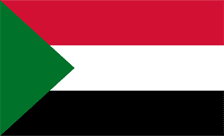
Sudan (officially the Republic of Sudan) is the largest country in Africa and tenth largest country in the world by area. It is bordered by Egypt to the north, the Red Sea to the northeast, Eritrea and Ethiopia to the east, Kenya and Uganda to the southeast, Democratic Republic of the Congo and the Central African Republic to the southwest, Chad to the west and Libya to the northwest. The country's name derives from the Arabic Bilad-al-sudan, literally "land of the blackened. Sudan is situated in northern Africa, bordering the Red Sea and it has a coastline of 853 km along the Red Sea. With an area of 2,505,810 square kilometres (967,499 sq mi), it is the largest country in the continent and tenth largest in the world. It borders the countries of Central African Republic, Chad, Democratic Republic of the Congo, Egypt, Eritrea, Ethiopia, Kenya, Libya and Uganda. It is dominated by the River Nile and its tributaries.
The terrain is generally flat plains, broken by several mountain ranges; in the west the Jebel Marra is the highest range; in the south is the highest mountain Mount Kinyeti Imatong, near the border with Uganda; in the east are the Red Sea Hills.
The Blue and White Niles meet in Khartoum to form the River Nile, which flows northwards through Egypt to the Mediterranean Sea. Blue Nile's course through Sudan is nearly 800 km long and is joined by the rivers Dinder and Rahad between Sennar and Khartoum. The White Nile within Sudan has no significant tributaries.
The amount of rainfall increases towards the south. In the north there is the very dry Nubian Desert; in the south there are swamps and rain forest. Sudan’s rainy season lasts for about three months (July to September) in the north, and up to six months (June to November) in the south. The dry regions are plagued by sand storms, known as haboob, which can completely block out the sun. In the northern and western semi-desert areas, people rely on the scant rainfall for basic agriculture and many are nomadic, traveling with their herds of sheep and camels. Nearer the River Nile, there are well-irrigated farms growing cash crops.
There are several dams on the Blue and White Niles. Among them are the Sennar and Roseires on the Blue Nile, and Jebel Aulia dam on the White Nile. There is also Lake Nubia on the Sudan-Egyptian border.
Rich mineral resources are available in Sudan including: petroleum, natural gas, gold, silver, chromite, asbestos, manganese, gypsum, mica, zinc, iron, lead, uranium, copper, kaolin, cobalt, granite, nickel and tin.
Desertification is a serious problem in Sudan. There is also concern over soil erosion. Agricultural expansion, both public and private, has proceeded without conservation measures. The consequences have manifested themselves in the form of deforestation, soil desiccation, and the lowering of soil fertility and the water table.
The nation's wildlife is threatened by hunting. As of 2001, twenty-one mammal species and nine bird species are endangered, as well as two types of plants. Endangered species include: the waldrapp, northern white rhinoceros, tora hartebeest, slender-horned gazelle, and hawksbill turtle. The Sahara oryx has become extinct in the wild.
In May 2007, it was announced that hundreds of wild elephants have been located on a previously unknown, treeless island in the Sudd swampland region of southern Sudan. The exact location being kept secret to protect the animals from poachers. |