
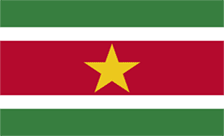
Suriname, (Dutch: Republiek van Suriname), officially the Republic of Suriname (traditionally spelled Surinam in English, but lately the Dutch spelling is more widely accepted; in Sranan Tongo Sranan), is a country in northern South America. Suriname was formerly known as Nederlands Guyana, Netherlands Guiana or Dutch Guiana. Suriname is situated between French Guiana to the east and Guyana to the west. The southern border is shared with Brazil and the northern border is the Atlantic coast. The southernmost border with French Guiana is disputed along the Marowijne river; while the once-disputed boundary with Guyana was arbitrated by the United Nations Convention on Law of the Sea on September 20, 2007. The country is the smallest sovereign state in terms of area and population in South America. Suriname is the smallest independent country in South America. Situated on the Guiana Shield, the country can be divided into two main geographic regions. The northern, lowland coastal area (roughly above the line Albina-Paranam-Wageningen) has been cultivated, and most of the population lives here. The southern part consists of tropical rainforest and sparsely inhabited savanna along the border with Brazil, covering about 80% of Suriname's land surface.
There are two main mountain ranges in Suriname: the Bakhuys Mountains and the Van Asch Van Wijck Mountains. Julianatop is the highest mountain in the country at 1,286 metres (4,219 ft) above sea level. Other mountains include Tafelberg (1,026 m; 3,366 ft), Mount Kasikasima (718 m; 2,356 ft), Goliathberg (358 m; 1,174 ft) and Voltzberg (240 m; 787 ft).
Lying on the equator, Suriname has a very hot tropical climate, and temperatures do not vary a lot throughout the year. The year has two wet seasons, from April to August and from November to February. It also has two dry seasons, from August to November and February to April.
Located in the northeast portion of the country is the Brokopondo Reservoir, one of the largest reservoir lakes in the world. It was created in 1964 by the Afobakka dam (the Brokopondo Project), built to provide hydropower for the bauxite industry (which consumes about 75% of the output) and for domestic consumption.
In the upper Coppename River watershed, the Central Suriname Nature Reserve is a UNESCO World Heritage Site cited for its unspoiled rainforest biodiversity. There are many national parks in the country: Galibi National Reserve, Coppename Manding National Park and Wia Wia NR along the coast, Brownsberg NR, Raleighvallen/Voltzeberg NR, Tafelberg NR and Eilerts de Haan NP in the centre and the Sipaliwani NR on the Brazilian border. In all, 12% of the country's land area are national parks and lakes. |