
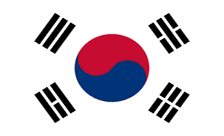
.pe.kr South Korea Country Information
South Korea, officially the Republic of Korea and often referred to as Korea, listen (help·info)) is an East Asian country occupying the southern half of the Korean Peninsula. To the north, it is bordered by North Korea, with which it was united until 1945. To the west, across the Yellow Sea, lies China and to the southeast, across the Korea Strait, lies Japan. The capital and largest city of South Korea is Seoul, the world's second largest metropolitan city. The official language of South Korea is Korean and is currently the tenth most spoken language in the world. Its Korean name means "The Great Nation of the Korean People" and is sometimes referred to as the "Land of the Morning Calm".
Korea is one of the oldest civilizations in the world, with the nation's founding dating back to 2333 BC by the legendary Dangun Wanggeom. Archaeological research shows Koreans have inhabited the peninsula as early as the Lower Paleolithic. Following the unification of the Three Korean Kingdoms under Silla in 668 AD, Korea went through the Goryeo and Joseon Dynasty as one nation until the end of the Korean Empire in 1910. Since division and the establishment of the modern republic in 1948, South Korea has struggled with the aftermath of Japanese exploitation (19101945) and the Korean war (19501953). However, as the standard of living and income rose considerably in the 1980s, nationwide demonstrations led to the collapse of the authoritarian government in 1987, and direct and fair elections have been held every 5 years thereafter. Today, South Korea is an established pioneer of stable democracy in Asia, with South Korean citizens enjoying one of the highest level of political freedom and social rights in Asia.
South Korea is a major global economic power and one of the wealthiest countries in Asia - it had one of the most successful and fastest growing economies in the world since the 1960s. The South Korean economy is highly developed and the third largest in Asia and the 12th largest in the world. South Korea has a High HDI of 0.921 and is defined as a High Income Nation by the World Bank and an Advanced Economy by the IMF and CIA. Forming the G20 industrial nations, it is one of the world's top 10 exporters, the world's sixth largest foreign exchange reserves holder and an international military power, having the world's sixth largest armed forces and the world's tenth highest defence budget. It was a founding member of APEC, joining the OECD in 1996, a milestone in its development history. In the late 20th century, many people referred to South Korea as an Asian Tiger and a NIC due to its reputation for strong economic growth. It is still among the world's fastest growing developed countries and a Next Eleven state, expected to surpass the income per head of Germany, United Kingdom and France in less than one decade. Today, many developing countries refer to its economic success as the "Miracle on the Han River", using South Korea's success story as a role model. International recognition of the country and its goods & services was enhanced by the hosting of the 1988 Summer Olympics and further boosted by the co-hosting of the 2002 FIFA World Cup.
South Korea is one of the world's leading countries in science and technology and in a heated competition with Japan in many global industries. South Korea is a world leader in information and communication technology such as electronics, computers, LCD displays, semiconductors, mobile phones and high-tech gadgets, lead by the two multinationals, Samsung and LG. South Korea has the world's most advanced IT infrastructure and is the only country in the world having nationwide coverage of DMB, WiBro, HSDPA, WiFi and HDTV technology and is the most wired nation in the world, with more than 95% of all homes connected to 100Mbit/s high speed broadband internet. Boasting the world's third largest steel producer, POSCO, South Korea is the world's largest shipbuilder and the world's fifth largest automobile manufacturing nation, headed by Hyundai and Kia. South Korea is also the world's leading construction contractor, having built the tallest buildings of mankind in the world, such as the Burj Dubai, Taipei 101 and Petronas Twin Towers. Other important industries include biotechnology and robotics, with the world's first cloned dog, Snuppy, the world's second walking humanoid robot, HUBO and the world's second female android EveR-1. South Korea occupies the southern portion of the Korean Peninsula, which extends some 680 miles (1,100 km) from the Asian mainland. This mountainous peninsula is flanked by the Yellow Sea to the west, and the Sea of Japan (East Sea) to the east. Its southern tip lies on the Korea Strait and the East China Sea.
The country's total area is 38,462.49 square miles (99,617.39 km²).
South Korea can be divided into four general regions: an eastern region of high mountain ranges and narrow coastal plains; a western region of broad coastal plains, river basins, and rolling hills; a southwestern region of mountains and valleys; and a southeastern region dominated by the broad basin of the Nakdong River.
South Korea's land is mostly mountainous, most of which is not arable. Lowlands, located primarily in the west and southeast, constitute only 30% of the total land area.
About three thousand islands, mostly small and uninhabited, lie off the western and southern coasts of South Korea. Jeju-do is located about 100 kilometers (about 60 mi) off the southern coast of South Korea. It is the country's largest island, with an area of 1,845 square kilometres (712 sq mi). Jeju is also the site of South Korea's highest point: Hallasan, an extinct volcano, reaches 1,950 metres (6,398 ft) above sea level. The most eastern islands of South Korea include Ulleungdo and Dokdo, while Marado and Ieodo are the southernmost islands of South Korea.
|