
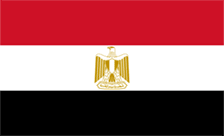
Egypt, officially the Arab Republic of Egypt, is a country in North Africa that includes the Sinai Peninsula, a land bridge to Asia. Covering an area of about 1,001,450 square kilometers (386,660 sq mi), Egypt borders Libya to the west, Sudan to the south and the Gaza Strip and Israel to the east. The northern coast borders the Mediterranean Sea; the eastern coast borders the Red Sea.
Egypt is one of the most populous countries in Africa. The great majority of its estimated 80 million people (2007) live near the banks of the Nile River, in an area of about 40,000 square kilometers (15,000 sq mi), where the only arable agricultural land is found. The large areas of the Sahara Desert are sparsely inhabited. About half of Egypt's residents live in urban areas, with the majority spread across the densely-populated centres of greater Cairo, Alexandria and other major cities in the Nile Delta.
Egypt is famous for its ancient civilization and some of the world's most famous monuments, including the Giza pyramid complex and its Great Sphinx. The southern city of Luxor contains numerous ancient artefacts, such as the Karnak Temple and the Valley of the Kings. Egypt is widely regarded as an important political and cultural nation of the Middle East. At 1,001,450 square kilometers (386,660 sq mi), Egypt is the world's 38th-largest country (after Mauritania). It is comparable in size to Tanzania, twice the size of France, four times the size of the United Kingdom, and is more than half the size of the US state of Alaska.
Nevertheless, due to the aridity of Egypt's climate, population centres are concentrated along the narrow Nile Valley and Delta, meaning that approximately 99% of the population uses only about 5.5% of the total land area.
The Coastline of Alexandria, Egypt's second largest cityEgypt is bordered by Libya to the west, Sudan to the south, and by the Gaza Strip and Israel to the east. Egypt's important role in geopolitics stems from its strategic position: a transcontinental nation, it possesses a land bridge (the Isthmus of Suez) between Africa and Asia, which in turn is traversed by a navigable waterway (the Suez Canal) that connects the Mediterranean Sea with the Indian Ocean via the Red Sea.
Apart from the Nile Valley, the majority of Egypt's landscape is a sandy desert. The winds blowing can create sand dunes more than 100 feet (30 m) high. Egypt includes parts of the Sahara Desert and of the Libyan Desert. These deserts were referred to as the "red land" in ancient Egypt, and they protected the Kingdom of the Pharaohs from western threats.
Towns and cities include Alexandria, one of the greatest ancient cities, Aswan, Asyut, Cairo, the modern Egyptian capital, El-Mahalla El-Kubra, Giza, the site of the Pyramid of Khufu, Hurghada, Luxor, Kom Ombo, Port Safaga, Port Said, Sharm el Sheikh, Suez, where the Suez Canal is located, Zagazig, and Al-Minya. Oases include Bahariya, el Dakhla, Farafra, el Kharga and Siwa. Protectorates include Ras Mohamed National Park, Zaranik Protectorate and Siwa. See Egyptian Protectorates for more information. |