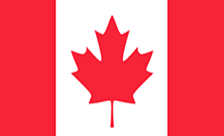
.nu.ca Domain Registration Canadian - Canada Domain Name Registration for .nu.ca

Canada Domain - .nu.ca Domain Registration Map
Country Information for Canada

Canada is a country occupying most of northern North America, extending from the Atlantic Ocean in the east to the Pacific Ocean in the west and northward into the Arctic Ocean. It is the world's second largest country by total area, and shares land borders with the United States to the south and northwest.

The lands have been inhabited for millennia by various groups of aboriginal peoples. Beginning in the late 15th century, British and French expeditions explored and later settled the Atlantic coast. France ceded nearly all of its colonies in North America in 1763 after the Seven Years War... - Read more about Canada Domain Name .nu.ca

ALL Canada DOMAINS
.ca Canada
.ab.ca Canada
.bc.ca Canada
.mb.ca Canada
.nb.ca Canada
.nl.ca Canada
.ns.ca Canada
.nt.ca Canada
.nu.ca Canada
.on.ca Canada
.pe.ca Canada
.qc.ca Canada
.sk.ca Canada
.yk.ca Canada
.nf.ca Canada
.qc.com Canada
.nu.ca Canada Country Information

Canada is a country occupying most of northern North America, extending from the Atlantic Ocean in the east to the Pacific Ocean in the west and northward into the Arctic Ocean. It is the world's second largest country by total area, and shares land borders with the United States to the south and northwest.

The lands have been inhabited for millennia by various groups of aboriginal peoples. Beginning in the late 15th century, British and French expeditions explored and later settled the Atlantic coast. France ceded nearly all of its colonies in North America in 1763 after the Seven Years War. In 1867, with the union of three British North American colonies through Confederation, Canada was formed as a federal dominion of four provinces. This began an accretion of additional provinces and territories and a process of increasing autonomy from the United Kingdom, highlighted by the Statute of Westminster in 1931 and culminating in the Canada Act in 1982 which severed the vestiges of legal dependence on the British parliament.

A federation now comprising ten provinces and three territories, Canada is a parliamentary democracy and a constitutional monarchy, with Queen Elizabeth II as its head of state. It is a bilingual and multicultural country, with both English and French as official languages at the federal level. Technologically advanced and industrialized, Canada maintains a diversified economy that is heavily reliant upon its abundant natural resources and upon trade- particularly with the United States, with which Canada has a long and complex relationship.


Canada occupies a major northern portion of North America, sharing land borders with the contiguous United States to the south and with the US state of Alaska to the northwest, stretching from the Atlantic Ocean in the east to the Pacific Ocean in the west; to the north lies the Arctic Ocean. By total area (including its waters), Canada is the second largest country in the world, after Russia, and largest on the continent. By land area it ranks fourth, after Russia, China, and the United States. Since 1925, Canada has claimed the portion of the Arctic between 60°W and 141°W longitude, but this claim is not universally recognized. The northernmost settlement in Canada and in the world is Canadian Forces Station (CFS) Alert on the northern tip of Ellesmere Island- latitude 82.5°N- just 817 kilometers (450 nautical miles) from the North Pole. Canada has the longest coastline in the world: 243,000 kilometers.

The population density, 3.5 inhabitants per square kilometer (9.1/sq mi), is among the lowest in the world. The most densely populated part of the country is the Quebec City-Windsor Corridor along the Great Lakes and Saint Lawrence River in the southeast. To the north of this region is the broad Canadian Shield, an area of rock scoured clean by the last ice age, thinly soiled, rich in minerals, and dotted with lakes and rivers. Canada by far has more lakes than any other country and has a large amount of the world's freshwater.

The Horseshoe Falls in Niagara Falls, Ontario, one of the world's most voluminous waterfalls,a major source of hydroelectric power, and a tourist destination.

In eastern Canada, the Saint Lawrence River widens into the Gulf of Saint Lawrence, the world's largest estuary, which contains the island of Newfoundland. South of the Gulf, the Canadian Maritimes protrude eastward along the Appalachian Mountain range from northern New England and the Gaspé Peninsula of Quebec. New Brunswick and Nova Scotia are divided by the Bay of Fundy, which experiences the world's largest tidal variations. Ontario and Hudson Bay dominate central Canada. West of Ontario, the broad, flat Canadian Prairies spread toward the Rocky Mountains, which separate them from British Columbia.

In western Canada, the Mackenzie River flows from the Great Slave Lake to the Arctic Ocean. A tributary of a tributary of the Mackenzie is the South Nahanni River, which is home to Virginia Falls, a waterfall about twice as high as Niagara Falls.

Northern Canadian vegetation tapers from coniferous forests to tundra and finally to Arctic barrens in the far north. The northern Canadian mainland is ringed with a vast archipelago containing some of the world's largest islands.

Average winter and summer high temperatures across Canada vary depending on the location. Winters can be harsh in many regions of the country, particularly in the interior and Prairie provinces which experience a continental climate, where daily average temperatures are near -15 °C (5 °F) but can drop below -40 °C (-40 °F) with severe wind chills. In non-coastal regions, snow can cover the ground almost six months of the year (more in the north). Coastal British Columbia is an exception and enjoys a temperate climate with a mild and rainy winter.

On the east and west coast average high temperatures are generally in the low 20s °C (70s °F), while between the coasts the average summer high temperature ranges from 25 to 30 °C (75 to 85 °F) with occasional extreme heat in some interior locations exceeding 40 °C (104 °F). For a more complete description of climate across Canada see Environment Canada's Website.

All Canada Domain Extensions Available
Country Code Top Level Domain designated for Canada
.ca
Second Level Domains - SLDs
.ab.ca.bc.ca.mb.ca.nb.ca.nl.ca.ns.ca.nt.ca.on.ca.pe.ca.qc.ca.sk.ca.yk.ca.nf.ca.qc.com
Trademark Domain Registration
Trademark Registration in Canada
 
Canada Trademark Registration
 

Choose Your Language

101domain.com in English - English
101domain.com in Spanish - Español
101domain.com in Hindi - हिन्दी
101domain.com in Russian - Русский
101domain.com in Portuguese Português

Leader in International Domain Registration