
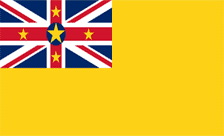
Niue is an island nation located in the South Pacific Ocean. It is commonly known as the "Rock of Polynesia." Natives of the island call it "the Rock." Although self-governing, Niue is in free association with New Zealand, meaning that the Sovereign in Right of New Zealand is also Niue's head of state. Most diplomatic relations are conducted by New Zealand on Niue's behalf. Niue is located 2,400 kilometres northeast of New Zealand in a triangle between Tonga, Samoa, and the Cook Islands. The Niuean language and the English language are both taught in schools and used in day-to-day business and communications. The people are predominantly Polynesian. Niue is a 269 kmē island located in the southern Pacific Ocean, east of Tonga. The geographic coordinates of Niue are 19°03'48"S, 169°52'11"W.
There are three geographically outlying coral reefs within the Exclusive Economic Zone that do not have any land area:- Beveridge Reef, at 20°00'S, 167°48'W, 240 km southeast, submerged atoll drying during low tide, 9.5 km North-South, 7.5 km East-West, total area 56 kmē, no land area, lagoon 11 meters deep, Antiope Reef, at 18°15'S, 168°24'W, 180 km southeast, is a circular plateau approximately 400 meters in diameter, with a least depth of 9.5 meters, Haran Reef (Harans Reef), at 21°33'S, 168°55'W, reported to break furiously, 294 km southeast, Albert Meyer Reef, at 20°53'S, 172°19'W, almost 5 km long and wide, least depth 3 meters, 326 km southwest, not officially claimed by Niue, Haymet Rocks, at 26°S, 160°W, 1273 km ESE, existence doubtful.
Niue is one of the world's largest coral islands. The terrain of Niue consists of steep limestone cliffs along the coast with a central plateau rising to about 60 metres above sea level. A coral reef surrounds the island, with the only major break in the reef being in the central western coast, close to the capital, Alofi. A notable feature of the island is the number of limestone caves found close to the coast.
The island is roughly oval in shape (with a diameter of about 18 kilometres), with two large bays indenting the western coast (Alofi Bay in the centre and Avatele Bay in the south). Between these is the promontory of Halagigie Point. A small peninsula, TeP? Point (or Blowhole Point), is located close to the settlement of Avatele in the southwest. Most of the island's population resides close to the west coast, around the capital, and in the northwest.
The island has a tropical climate, with most rainfall occurring between November and April.
Some of the soils on the island are geochemically very unusual. They are extremely highly weathered tropical soils, with high levels of iron and aluminium oxides (oxisol), but as established by the research of New Zealand scientists starting with Sir Ernest Marsden, they contain surprisingly high levels of natural radioactivity. There is almost no uranium, but the radionucleides Th-230 and Pa-231 head the decay chains. This is the same distribution of elements as found naturally on very deep seabeds, but the geochemical evidence suggests that in the case of Niue the origin is extreme weathering of coral and brief sea submergence 120,000 years ago. A process, "endothermal upwelling" in which mild natural volcanic heat entrains deep seawater up through the porous coral may also contribute.
No adverse health effects from the radioactivity have been demonstrated and calculations show that level of radioactivity would probably be much too low to be detected in the population.
These unusual soils are very rich in phosphate, but it is not accessible to plants, being in the very insoluble form of iron phosphate, or crandallite.
It is thought that rather similar radioactive soils may exist on Lifou and Mare (island) near New Caledonia, and Rennell in the Solomon Islands, but no other locations are known. |