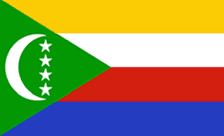
The Comoros officially the Union of the Comoros is an island nation in the Indian Ocean, located off the eastern coast of Africa on the northern end of the Mozambique Channel between northern Madagascar and northeastern Mozambique. The nearest countries to the Comoros are Mozambique, Tanzania, Madagascar, and the Seychelles. Prior to 2002, it was known officially as the Islamic Federal Republic of the Comoros. At 2,235 km² (863 sq mi) the Comoros is the third smallest African nation by area; and with a population estimated at 798,000 it is the sixth smallest African nation by population (though it has one of the highest population densities in Africa). Its name derives from the Arabic word qamar ("moon").
The country officially consists of the four islands in the volcanic Comoros archipelago: Ngazidja (French: Grande Comore), Mwali (French: Mohéli), Nzwani (French: Anjouan), and Mahoré (French: Mayotte), as well as many smaller islands. However, the government of the Union of the Comoros (or its predecessors since independence) has never administered the island of Mayotte, which France considers an overseas community and still administers. Since Mayotte was the only island in the archipelago that voted against independence from France, and France has vetoed United Nations Security Council resolutions that would affirm Comorian sovereignty over the island, control was never passed to the Comoros.
The country is notable for its diverse culture and history, as a nation formed at the crossroads of many civilizations. It has three official languages—Comorian (Shikomor), Arabic, and French, and it is the only state to be a member of each of the African Union, Francophonie, Organisation of the Islamic Conference, Arab League, and Indian Ocean Commission, among other international organizations. However it has had a troubled history since independence in 1975, marked by an inordinate number of coups d'état. The Comoros is formed by Ngazidja (Grande Comore), Mwali (Mohéli), Nzwani (Anjouan), and Mahoré (Mayotte), the major islands in the Comoros Archipelago, as well as many minor islets. The islands are officially known by their Comorian language names, though international sources still use their French names (in parentheses) commonly. The capital and largest city, Moroni, is located on Ngazidja. The archipelago is situated in the Indian Ocean, in the Mozambique Channel, between the African coast (nearest to Mozambique and Tanzania) and Madagascar, with no land borders. At 2,235 km² (863 sq mi), it is one of the smallest countries in the world. The Comoros also has claim to 320 km² (124 sq mi) of territorial seas. The interiors of the islands vary from steep mountains to low hills. The climate is generally tropical and mild, and the two major seasons are distinguishable by their relative raininess. The temperature reaches an average of 29-30°C (84-86°F) in March, the hottest month in the rainy season (December to April), and an average low of 19°C (66°F) in the cool, dry season (May to November). The islands are subject to cyclones during rainy season which are strong enough to devastate the infrastructure about twice every decade.
Ngazidja is the largest of the Comoros Archipelago, approximately equal in area to the other islands combined. It is also the most recent island, and therefore has rocky soil. The island's two volcanoes, Karthala and La Grille, and the lack of good harbors are distinctive characteristics of its terrain. Mwali, with its capital at Fomboni, is the smallest of the four major islands. Nzwani, whose capital is Mutsamudu, has a distinctive triangular shape caused by three mountain chains, Sima, Nioumakele, and Jimilime, emanating from a central peak, Mtingui (1,575 m, 5,177 ft). The oldest of the islands, Mahoré has the richest soil as well as good harbors and local fish populations, due to its ring of coral reefs. Dzaoudzi, a previous capital of all the colonial Comoros, is located on Pamanzi, (French: Petite-Terre), the largest islet of Mahoré. Mahoré's current capital is at Mamoudzou. The term Mayotte (or Mahoré) may also refer to the group of islands, of which the largest is known as Mahoré (French: Grande-Terre), and it includes Mahoré's surrounding islands, most notably Pamanzi (Petite-Terre).
The islands of the Comoros Archipelago were formed by volcanic activity. Mount Karthala, an active shield volcano located on Ngazidja, is the country's highest point, at 2,361 m or 7748 ft. It contains the Comoros' largest patch of its disappearing rainforest. Karthala is currently one of the most active volcanoes in the world, with a minor eruption in May 2006, and prior eruptions as recently as April 2005 and 1991. In the 2005 eruption, which lasted from April 17 to 19, 40,000 citizens were evacuated, and the crater lake in the volcano's 3 by 4 km (2 by 2½ mi) caldera was destroyed.
The Comoros also lays claim to the Glorioso Islands, comprised of Grande Glorieuse, Île du Lys, Wreck Rock, South Rock, Verte Rocks (three islets), and three unnamed islets, one of France's Îles Éparses or Îles éparses de l'océan indien (Scattered islands in the Indian Ocean) possessions. The Glorioso Islands were administered by the colonial Comoros before 1975, and are therefore sometimes considered part of the Comoros Archipelago. Banc du Geyser, a former island in the Comoros Archipelago, now submerged, is geographically located in the Îles Éparses, but was annexed by Madagascar in 1976 as an unclaimed territory. The Comoros now claims it as part of its exclusive economic zone. |