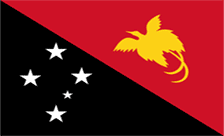
Papua New Guinea, is a country in Oceania, occupying the eastern half of the island of New Guinea and numerous offshore islands (the western portion of the island is a part of Indonesian provinces of Papua and West Papua). It is located in the southwestern Pacific Ocean, in a region defined since the early 19th century as Melanesia. Its capital, and one of its few major cities, is Port Moresby. It is one of the most diverse countries on Earth, with over 850 indigenous languages and at least as many traditional societies, out of a population of just under 6 million. It is also one of the most rural, with only 18 per cent of its people living in urban centres. The country is also one of the world's least explored, culturally and geographically, and many undiscovered species of plants and animals are thought to exist in the interior of Papua New Guinea.
The majority of the population live in traditional societies and practise subsistence-based agriculture. These societies and clans have some explicit acknowledgement within the nation's constitutional framework. The PNG Constitution (Preamble 5(4)) expresses the wish for traditional villages and communities to remain as viable units of Papua New Guinean society, and for active steps to be taken in their preservation. The PNG legislature has enacted various laws in which a type of tenure called "customary land title" is recognised, meaning that the traditional lands of the indigenous peoples have some legal basis to inalienable tenure. This customary land notionally covers most of the usable land in the country (some 97% of total land area); alienated land is either held privately under State Lease or is government land. Freehold Title (also known as fee simple) can only be held by Papua New Guinea citizens.
The country's geography is similarly diverse and, in places, extremely rugged. A spine of mountains runs the length of the island of New Guinea, forming a populous highlands region. Dense rainforests can be found in the lowland and coastal areas. This terrain has made it difficult for the country to develop transportation infrastructure. In some areas, planes are the only mode of transport. After being colonised by three external powers since 1884, Papua New Guinea gained its independence from Australia in 1975. At 462,840 kmē (178,704 sq mi), Papua New Guinea is the world's fifty-fourth largest country (after Cameroon). It is comparable in size to Sweden, and somewhat larger than the US state of California.
Papua New Guinea is mostly mountainous (highest peak: Mount Wilhelm at 4,509 m; 14,793 ft) and mostly covered with tropical rainforest, as well as very large wetland areas surrounding the Sepik and Fly rivers. Papua New Guinea is surrounded by coral reefs which are under close watch to preserve them.
The country is situated on the Pacific Ring of Fire, at the point of collision of several tectonic plates. There are a number of active volcanoes and eruptions are frequent. Earthquakes are relatively common, sometimes accompanied by tsunamis.
The mainland of the country is the eastern half of New Guinea island, where the largest towns are also located, including the capital Port Moresby and Lae; other major islands within Papua New Guinea include New Ireland, New Britain, Manus and Bougainville.
Papua New Guinea is one of the few regions close to the equator that experience snowfall, which occurs in the most elevated parts of the mainland. |