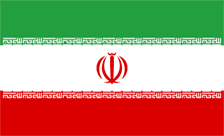
.ir Iran Country Information
Iran, officially the Islamic Republic of Iran and formerly known internationally as Persia until 1935, is a country in Central Eurasia. Iran is bounded by the Gulf of Oman and the Persian Gulf to the south and the Caspian Sea to its north. Shi'a Islam is the official religion, and Persian is the official language. The 18th largest country in the world in terms of area at 1,648,195 km², Iran has a population of over seventy million. Iran borders Armenia, Azerbaijan, Turkmenistan to the north, Afghanistan and Pakistan to the east, and Turkey and Iraq to the west. Being a littoral state of the Caspian sea (an internal sea and condominium), also Kazakhstan and Russia are Iran's direct neighbors.
Iran is home to one of the world's oldest continuous major civilizations, with historical and urban settlements dating back to 4000 BC. Throughout history, Iran has been of geostrategic importance because of its central location in Eurasia and is a regional power. Iran is a founding member of the UN, NAM, OIC, and OPEC. The political system of Iran, based on the 1979 Constitution, comprises several intricately connected governing bodies. The highest state authority is the Supreme Leader, currently Ayatollah Ali Khamenei.
Iran occupies an important position in international energy security and world economy as a result of of its large reserves of petroleum and natural gas. The name Iran is a cognate of Aryan, and means "Land of the Aryans". "Land of Kindness" is used as an alternative name for Iran in Persian literature and Iranian media. Iran is the eighteenth largest country in the world after Libya and before Mongolia. Its area roughly equals that of the United Kingdom, France, Spain, and Germany combined, or slightly less than the state of Alaska. Its borders are with Azerbaijan (432 km/268 mi) and Armenia (35 km/22 mi) to the north-west; the Caspian Sea to the north; Turkmenistan (992 km/616 mi) to the north-east; Pakistan (909 km/565 mi) and Afghanistan (936 km/582 mi) to the east; Turkey (499 km/310 mi) and Iraq (1,458 km/906 mi) to the west; and finally the waters of the Persian Gulf and the Gulf of Oman to the south. Iran's area is 1,648,000 km² (approximately 636,300 sq mi).
Mount Damavand is Iran's highest point.Iran consists of the Iranian Plateau with the exception of the coasts of the Caspian Sea and Khuzestan. It is one of the world's most mountainous countries, its landscape dominated by rugged mountain ranges that separate various basins or plateaux from one another. The populous western part is the most mountainous, with ranges such as the Caucasus, Zagros and Alborz Mountains; the latter contains Iran's highest point, Mount Damavand at 5,604 m (18,386 ft), which is not only the country's highest peak but also the highest mountain on the Eurasian landmass west of the Hindu Kush. The eastern part consists mostly of desert basins like the saline Dasht-e Kavir, Iran's largest desert, in the north-central portion of the country, and the Dasht-e Lut, in the east, as well as some salt lakes. This is because the mountain ranges are too high for rain clouds to reach these regions. The only large plains are found along the coast of the Caspian Sea and at the northern end of the Persian Gulf, where Iran borders the mouth of the Shatt al-Arab (or the Arvand R?d) river. Smaller, discontinuous plains are found along the remaining coast of the Persian Gulf, the Strait of Hormuz and the Sea of Oman.
Eurasian LynxIran's climate is mostly arid or semiarid, to subtropical along the Caspian coast. On the northern edge of the country (the Caspian coastal plain) temperatures nearly fall below freezing and it remains humid for the rest of the year. Summer temperatures rarely exceed 29 °C (85 °F). Annual precipitation is 680 mm (27 in) in the eastern part of the plain and more than 1,700 mm (67 in) in the western part. To the west, settlements in the Zagros basin experience lower temperatures, severe winters with below zero average daily temperatures and heavy snowfall. The eastern and central basins are arid, with less than 200 mm (eight in) of rain, and have occasional deserts. Average summer temperatures exceed 38 °C (100 °F). The coastal plains of the Persian Gulf and Gulf of Oman in southern Iran have mild winters, and very humid and hot summers. The annual precipitation ranges from 135 to 355 mm (five to fourteen inches).
Bears in the mountains, wild sheep and goats, gazelles, wild asses, wild pigs, wolves, jackals, panthers, Eurasian lynxes, and foxes abound. Domestic animals include sheep, goats, cattle, horses, water buffalo, donkeys, and camels. The pheasant, partridge, stork, eagle and falcon are native to Iran.
|