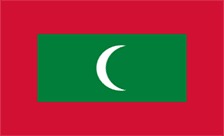
The Maldives (or Maldive Islands), officially the Republic of Maldives, is an island nation consisting of a group of atolls in the Indian Ocean. The Maldives are located south of India's Lakshadweep islands, and about seven hundred kilometers (435 mi) south-west of Sri Lanka. The Maldives' twenty-six atolls encompass a territory featuring 1,192 islets, two hundred and fifty islands are inhabited.
The name "Maldives" may derive from Maale Dhivehi Raajje ("The Island Kingdom Malé"). Some scholars believe that the name "Maldives" derives from the Sanskrit maladvipa, meaning "garland of islands", or from mahila dvipa, meaning "island of women", but these names are not found in ancient Sanskrit literature. Instead, classical Sanskrit texts mention the "Hundred Thousand Islands" (Lakshadweepa); a generic name which would include not only the Maldives, but also the Laccadives and the Chagos island groups. Some medieval Arab travellers such as Ibn Batuta called the islands "Mahal Dibiyat" from the Arabic word Mahal ("palace"). This is the name presently inscribed in the scroll of the Maldive state emblem.
The inhabitants were Buddhist, probably since Ashoka's period, in the 3rd century BC. Islam was introduced in 1153. The Maldives came then under the influence of the Portuguese (1558) and the Dutch (1654) seaborne empires. And in 1887 it became a British protectorate. In 1965, the Maldives obtained independence from Britain (originally under the name "Maldive Islands"), and in 1968 the Sultanate was replaced by a Republic.
The Maldives is the smallest Asian country in terms of population. It is also the smallest predominantly Muslim nation in the world. The Maldives holds the record for being the flattest country in the world, with a maximum natural ground level of only 2.3 m (7˝ ft), though in areas where construction exists this has been increased to several meters. Over the last century, sea levels have risen about 20 centimeters (8 in); further rises of the ocean could threaten the existence of Maldives.
The first accurate maritime charts of this complex Indian Ocean atoll group were the British Admiralty Charts. In 1834-36 Capt. Robert Moresby, assisted by Lieutenants Christopher and Young, undertook the difficult cartography of the Maldive Islands. The resulting charts were printed as three separate large maps by the Hydrographic Service of the Royal Navy.
A tsunami in the Indian Ocean caused by the 2004 Indian Ocean earthquake caused parts of the Maldives to be covered by sea water and left many people homeless. After the disaster, cartographers are planning to redraw the maps of the islands due to alterations by the tsunami. |