
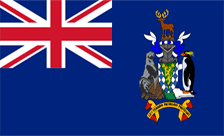
South Georgia and the South Sandwich Islands (SGSSI) is a British overseas territory in the southern Atlantic Ocean. It is a remote and inhospitable collection of islands, consisting of South Georgia – which measures approximately 106 miles (170 km) by 18 miles (29 km) and is by far the largest island in the territory – and a chain of smaller islands known as the South Sandwich Islands lying about 400 miles to the south-east.
There is no native population on any of the islands, and the only present inhabitants are the British Government Officer, Deputy Postmaster, scientists, and support staff from the British Antarctic Survey who maintain scientific bases at Bird Island and at the capital, King Edward Point, as well as museum staff at nearby Grytviken.
The British claim to sovereignty of South Georgia dates from 1775, and that of the South Sandwich Islands from 1908. The territory of "South Georgia and the South Sandwich Islands" was formed in 1985; previously it had been governed as part of the Falkland Islands Dependencies. Argentina claimed South Georgia in 1927, and the South Sandwich Islands in 1938. Argentina maintained a naval station, Corbeta Uruguay, at Port Faraday on Thule Island in the South Sandwich Islands from 1976 until 1982 when it was closed by the Royal Navy. The Argentine claim over South Georgia contributed to the 1982 Falklands War, during which Argentine forces briefly occupied the Island, and remains unresolved to this day (see also Sovereignty of the Falkland Islands). South Georgia and the South Sandwich Islands are a collection of bleak and remote islands in the South Atlantic Ocean. Most of the islands, rising steeply from the sea, are rugged and mountainous. At higher elevations the islands are permanently covered with ice and snow.
South Georgia Group
The South Georgia Group (Spanish name Georgias del Sur) lies about 1,390 kilometres (864 mi) east-southeast of the Falkland Islands, at 54°-55°S, 36°-38°W. It comprises South Georgia Island itself (by far the largest island in the territory), along with the islands that immediately surround it and some remote and isolated islets to the west and east-southeast. It has a total land area of 3,756 square kilometres (1,450 sq mi), including satellite islands (but excluding the South Sandwich Islands which form a separate island group).
Islands in the South Georgia Group
South Georgia Island, also called Pepys Island (San Pedro in Spanish), lies at 54°15'S 36°45'W? / ?-54.25, -36.75Coordinates: 54°15'S 36°45'W? / ?-54.25, -36.75 and has an area of 3,528 km². It is mountainous and largely barren. Eleven peaks rise to over 2,000 metres (6,562 ft) high, their slopes furrowed with deep gorges filled with glaciers (Fortuna Glacier being the largest). The highest peak is Mount Paget in the Allardyce Range at 2,934 metres (9,626 ft).
Geologically, the island consists of gneiss and argillaceous schists, with no trace of fossils, showing that the island is, like the Falkland Islands, a surviving fragment of some greater land-mass now vanished, most probably indicating a former extension of the Andean system.
Smaller islands and islets off the coast of South Georgia Island include:- Annenkov Island, Bird Island, Cooper Island, Grass Island, Pickersgill Islands, Welcome Islands, Willis Islands, Trinity Island
The following remote rocks are also considered part of the South Georgia Group:- Shag Rocks 185 km (115 mi) west-northwest of South Georgia Island, Black Rock 169 km (105 mi) west-northwest of South Georgia Island and 16 km (10 mi) southeast of the Shag Rocks, Clerke Rocks 56 km (35 mi) east-southeast of South Georgia Island
South Sandwich Islands
The South Sandwich Islands (Spanish name: Islas Sandwich del Sur) comprise 11 mostly volcanic islands (excluding tiny satellite islands and offshore rocks), with some active volcanoes. They form an island arc running from north to south in the region 56°18'–59°27'S, 26°23'–28°08'W, between about 350 miles (563 km) and 500 miles (805 km) south east of South Georgia.
The northernmost of the South Sandwich Islands form the Traversay Islands and Candlemas Islands groups, while the southernmost make up Southern Thule. The three largest islands – Saunders, Montagu and Bristol – lie between the two. The Islands' highest point is Mount Belinda (1,370 m / 4,495 ft) on Montagu Island.
The South Sandwich Islands are uninhabited, though a permanently manned Argentine research station was located on Thule Island from 1976 to 1982 (for details, see "History" section above). There are automatic weather stations on Thule (Morrell) Island and Zavodovski. To the northwest of Zavodovski Island is the Protector Shoal, a submarine volcano. |