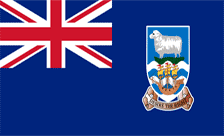
The Falkland Islands are an archipelago in the South Atlantic Ocean, located 300 miles (483 km) from the coast of Argentina, 671 miles (1,080 km) west of the Shag Rocks (South Georgia), and 584 miles (940 km) north of the British Antarctic Territory (which overlaps with the Argentine and Chilean claims to Antarctica in that region). They consist of two main islands, East Falkland and West Falkland, together with 776 smaller islands. Stanley, on East Falkland, is the capital. The islands are a self-governing Overseas Territory of the United Kingdom, but have been the subject of a claim to sovereignty by Argentina since the re-assertion of British sovereignty in 1833.
In pursuit of this claim in 1982, the islands were invaded by Argentina, precipitating the two-month-long undeclared Falklands War between Argentina and the United Kingdom, which resulted in the defeat and withdrawal of Argentine forces. Since the war there has been strong economic growth in both fisheries and tourism. The inhabitants of the islands are full British citizens (since a 1983 Act) and under Argentine Law are eligible for Argentine citizenship. Many trace their origins on the islands to early 19th-century Scottish immigration. The islands' residents reject the Argentine sovereignty claim. The Falkland Islands comprise two main islands, East Falkland and West Falkland (in Spanish Isla Gran Malvina and Isla Soledad respectively), and about 776 small islands. The total land area is 4,700 square miles (12,173 km²), approximately the same area as Connecticut or Northern Ireland, with a coastline estimated at 800 miles (1,288 km).
Much of the land is part of the two main islands separated by the Falkland Sound: East Falkland, home to the capital of Stanley and the majority of the population, and West Falkland. Both islands have mountain ranges, rising to 2,313 feet (705 m) at Mount Usborne on East Falkland. There are also some boggy plains, most notably Lafonia, on the southern half of East Falkland. Virtually the entire area of the islands is used as pasture for sheep.
Smaller islands surround the main two. They include Barren Island, Beaver Island, Bleaker Island, Carcass Island, George Island, Keppel Island, Lively Island, New Island, Pebble Island, Saunders Island, Sealion Island, Speedwell Island, Staats Island, Weddell Island, and West Point Island. The Jason Islands lie to the north west of the main archipelago, and Beauchene Island some distance to its south. Speedwell Island and George Island are split from East Falkland by Eagle Passage.
The islands claim a territorial sea of 12 nautical miles (22 km) and an exclusive fishing zone of 200 nautical miles (370 km), which has been a source of disagreement with Argentina.
Surrounded by cool South Atlantic waters, the Falkland Islands have a climate very much influenced by the ocean with a narrow annual temperature range of only 7°C. January averages about 9°C, with average daily high of 13°C, while July averages about 2°C with average daily high 4°C. Rainfall is relatively low at about 24 inches (610 mm). Humidity and winds, however, are constantly high. Snow is rare, but can occur at almost any time of year.
Biogeographically, the Falkland Islands are classified as part of the Neotropical realm, together with South America. It is also classified as part of the Antarctic Floristic Kingdom. |