
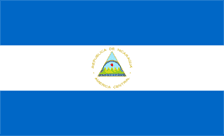
Nicaragua officially the Republic of Nicaragua, is a representative democratic republic and the largest nation in Central America. It is also the least densely populated with a demographic similar in size to its smaller neighbors. The country is bordered by Honduras to the north and by Costa Rica to the south. The Pacific Ocean lies to the west of the country, while the Caribbean Sea lies to the east. Falling within the tropics, Nicaragua sits 11 degrees north of the Equator, in the Northern Hemisphere.
The country's name is derived from Nicarao, the name of the Nahuatl-speaking tribe which inhabited the shores of Lago de Nicaragua before the Spanish conquest of the Americas, and the Spanish word Agua, meaning water, due to the presence of the large lakes Lago de Nicaragua and Lago de Managua, as well as lagoons and rivers in the region.
At the time of the Spanish conquest, Nicaragua was the name given to the narrow strip of land between Lake Nicaragua and the Pacific Ocean. Chief Nicarao ruled over the land when the first conquerors arrived. The term was eventually applied, by extension, to the Nicarao or Niquirano groups that inhabited that region.
The Nicarao tribe migrated to the area from northern regions after the fall of Teotihuacán, on the advice of their religious leaders. According to tradition, they were to travel south until they encountered a lake with two volcanoes rising out of the waters, and so they stopped when they reached Ometepe, the largest fresh-water volcanic island in the world. Nicaragua occupies a landmass of 129,494 km² - roughly the size of Greece or the state of New York and 1.5 times larger than Portugal. Close to 20% of the country's territory is designated as protected areas such as national parks, nature reserves and biological reserves. The country is bordered by Costa Rica on the south and Honduras on the north, with the Caribbean Sea to the east and the Pacific Ocean to the west.
Nicaragua has three distinct geographical regions: the Pacific Lowlands, the North-Central Mountains or highlands and the Atlantic Lowlands.
Pacific lowlands
Located in the west of the country, these lowlands consist of a broad, hot, fertile plain. Punctuating this plain are several large volcanoes of the Marrabios mountain range, including Mombacho just outside Granada, and Momotombo near León. The lowland area runs from the Gulf of Fonseca to Nicaragua's Pacific border with Costa Rica south of Lake Nicaragua. Lake Nicaragua is the largest freshwater lake in Central America (20th largest in the world), and is home to the world's only freshwater sharks (Nicaraguan shark). The Pacific lowlands region is the most populous, with over half of the nation's population. The capital city of Managua is the most populous and it is the only city with over 1 million inhabitants.
In addition to its beach and resort communities, the Pacific Lowlands is also the repository for much of Nicaragua's Spanish colonial heritage. Cities such as Granada and León abound in colonial architecture and artifacts. Granada, founded in 1524, is the oldest colonial city in the Americas.
Central highlands
This is an upland region away from the Pacific coast, with a cooler climate than the Pacific Lowlands. About a quarter of the country's agriculture takes place in this region, with coffee grown on the higher slopes. Oaks, pines, moss, ferns and orchids are abundant in the cloud forests of the region.
Bird life in the forests of the central region includes Resplendent Quetzal, goldfinches, hummingbirds, jays and toucanets.
Atlantic lowlands
This large rainforest region, with several large rivers running through it, is very sparsely populated. The Rio Coco is the largest river in Central America, it forms the border with Honduras. The Caribbean coastline is much more sinuous than its generally straight Pacific counterpart. Lagoons and deltas make it very irregular.
Nicaragua's Bosawas Biosphere Reserve is located in the Atlantic lowlands, it protects 1.8 million acres (7,300 km²) of Mosquitia forest - almost seven percent of the country's area - making it the largest rainforest north of the Amazon in Brazil.
Nicaragua's tropical east coast is very different from the rest of the country. The climate is predominantly tropical, with high temperature and high humidity. Around the area's principal city of Bluefields, English is widely spoken along with the official Spanish and the population more closely resembles that found in many typical Caribbean ports than the rest of Nicaragua.
A great variety of birds can be observed including eagles, turkeys, toucans, parakeets and macaws. Animal life in the area includes different species of monkeys, ant-eaters, white-tailed deer and tapirs. |