
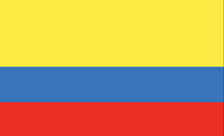
Colombia officially the Republic of Colombia, is a country located in northwestern South America. Colombia is bordered to the east by Venezuela and Brazil; to the south by Ecuador and Peru; to the north by the Atlantic Ocean, through the Caribbean Sea; to the north-west by Panama; and to the west by the Pacific Ocean. Colombia also shares maritime borders with the Caribbean countries of Jamaica, Haiti, the Dominican Republic and the Central American countries of Honduras, Nicaragua, and Costa Rica.
Colombia is the 26th largest nation in the world and the fourth-largest in South America (after Brazil, Argentina, and Peru), with an area more than twice that of France. It also has the third-largest population in Latin America after Brazil and Mexico.
The territory of what is now Colombia was originally inhabited by indigenous tribes which had migrated from North and Central America, including the Muisca, Quimbaya, and Tairona civilizations. To the south lay the Inca Empire. The Spanish first arrived in 1499, initiating a period of conquest and colonisation which ultimately led to the creation of the Viceroyalty of New Granada (comprising what is now Colombia, Venezuela, Ecuador and Panama) with its capital at Bogotá.
Independence from Spain was won in 1819, but by 1830 "Gran Colombia" had collapsed with the secession of Venezuela and Ecuador. Modern day Colombia, with Panama, emerged as the Republic of New Granada. The new nation experimented with federalism as the Granadine Confederation (1858), and then the United States of Colombia (1863), before the Republic of Colombia was finally declared in 1886. Panama seceded in 1903.
Colombia has a long tradition of constitutional government, and the Conservative and Liberal parties, founded in 1843 and 1848 respectively, are two of the oldest surviving political parties in the Americas. However, tensions between the two have frequently erupted into violence, most notably in the Thousand Days War (1899-1902) and La Violencia, beginning in 1948. Since the 1960s, conflict between government forces and anti-government insurgents and illegal paramilitary groups - both heavily funded by the cocaine trade - has been escalating, increasing dramatically in the 1990s. The insurgents lack the military or popular support necessary to overthrow the government, and violence has been decreasing since about 2002, but insurgents continue attacks against civilians and large swaths of the countryside are under guerrilla influence. More than 32,000 former paramilitaries had demobilized by the end of 2006 and the United Self Defense Forces of Colombia (AUC) as a formal organization had ceased to function. Still, some renegades continued to engage in criminal activities. The Colombian Government has stepped up efforts to reassert government control throughout the country, and now has a presence in every one of its municipalities.
Colombia is a standing middle power with the second largest Spanish-speaking population in the world after Mexico. It is also one of the largest manufacturers in South America. Colombia is very ethnically diverse, with a population comprising descendents of the original native inhabitants, Spanish colonisers, African slaves and twentieth-century immigrants from Europe and the Middle East. The interaction between these groups has produced an incredibly rich culture. Colombia is considered to be among 17 of the most megadiverse countries in the world. Colombia is the 26th largest nation in the world and the fourth-largest country in South America. Located in the northwestern region of South America, it is bordered to the east by Venezuela and Brazil; to the south by Ecuador and Peru; to the North by the Atlantic Ocean, through the Caribbean Sea; to the north-west by Panama; and to the west by the Pacific Ocean. Besides the countries in South America, the Republic of Colombia is recognized to share maritime borders with the Caribbean countries of Jamaica, Haiti, the Dominican Republic and the Central American countries of Honduras, Nicaragua, and Costa Rica. Colombia has more physical diversity packed into its borders than any other area of comparable size in Latin America. The country is part of the Pacific Ring of Fire, a region of the world subject to earthquakes and volcanic eruptions.
Geologically Colombia is formed by two great territorial zones, one submerged in the Pacific Ocean and the Caribbean sea covering a total area of 828,660 km² and the second is the emerged land which is formed by the Andes mountain range and the Llanos plains that are shared with Venezuela and cover an area of some 1'143,748 km². Colombian surface features form complicated land patterns. The western third of the country is the most complex, starting at the shore of the Pacific Ocean in the west and moving eastward at a latitude of 5 degrees north, a diverse sequence of features is encountered; In the extreme west are the very narrow and discontinuous Pacific coastal lowlands, which are backed by the Serranía de Baudó, one of the lowest and narrowest of Colombia's mountain ranges. Next is the broad region of the Río Atrato/Río San Juan lowland.
The western mountain range, the Cordillera Occidental, is a moderately high range with peaks reaching up to about 13,000 ft (4,000 m). The Cauca River Valley, an important agricultural region with several large cities on its borders, separates the Cordillera Occidental from the massive Cordillera Central. Several snow-clad volcanoes in the Cordillera Central have summits that rise above 18,000 ft (5,500 m). The valley of the Magdalena River, a major transportation artery, separates the Cordillera Central from the main eastern range, the Cordillera Oriental. The peaks of the Cordillera Oriental are moderately high. This range differs from Colombia's other mountain ranges in that it contains several large basins. To the east of the country, the sparsely populated, flat to gently rolling eastern lowlands called Llanos orientales part of the Orinoco river basin and the jungle covered Amazon region part of the Amazon river basin (both basins called eastern plains) cover almost 60 percent of the country's total land area. The northern plains are mostly part of the Caribbean natural region which includes the Sierra Nevada de Santa Marta mountain range, the highest mountain by the sea and the Guajira Peninsula, mostly arid with another separate formation from the Andes mountain range, the Serranía de Macuira to form the Guajira-Barranquilla xeric scrub. |