
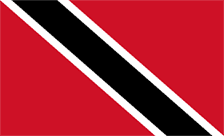
The Republic of Trinidad and Tobago is an archipelagic state in the southern Caribbean, lying northeast of the South American nation of Venezuela and south of Grenada in the Lesser Antilles. It also shares maritime boundaries with Barbados to the northeast and Guyana to the southeast. The country covers an area of 5,128 square kilometers (1,979 sq mi) and consists of two main islands, Trinidad and Tobago, and 21 smaller islands. Trinidad is the larger and more populous of the main islands; Tobago is much smaller, comprising about 6% of the total area and 4% of the population. The nation lies outside the hurricane belt.
Officially Trinidadians or Tobagonians, the people from Trinidad and Tobago are often informally referred to as Trinbagonians or Trinis (for Trinidadians). Unlike most of the English-speaking Caribbean, Trinidad and Tobago is a primarily industrialised country whose economy is based on petroleum and petrochemicals. Trinidad and Tobago is famous for its pre-Lenten Carnival and as the birthplace of steelpan, calypso, soca, and limbo.
The capital city, Port of Spain, is currently a leading candidate (along with Miami) to serve as the headquarters of the Permanent Secretariat of the Free Trade Area of the Americas (FTAA-ALCA). Trinidad and Tobago is also a member of the Commonwealth of Nations. Trinidad and Tobago are southeasterly islands of the Antilles or West Indies, situated between 10° 2' and 11° 12' N latitude and 60° 30' and 61° 56' W longitude. At the closest point, Trinidad is just 11 kilometres (7 miles) off the Venezuelan coast. Covering an area of 5,128 square kilometres (1,979 sq mi), the country consists of the two main islands, Trinidad and Tobago, and 21 smaller islands – including Chacachacare, Monos, Huevos, Gaspar Grande (or Gasparee), Little Tobago, and St. Giles Island. Trinidad is 4,768 square kilometres (1,841 sq mi) in area (comprising 93.0% of the country's total area) with an average length of 80 kilometres (50 mi) and an average width of 59 kilometres (37 mi). Tobago has an area of about 300 square kilometres (115 sq mi), or 5.8% of the country's area, is 41 kilometres (25.5 mi) long and 12 kilometres (7.5 mi) at its greatest width.
The terrain of the islands is a mixture of mountains and plains. The highest point in the country is found on the Northern Range at El Cerro del Aripo which is situated at 940 metres (3,085 ft) above sea level. The climate is tropical. There are two seasons annually: the dry season for the first six months of the year, and the wet season in the second half of the year. Winds are predominantly from the northeast and are dominated by the northeast trade winds. Unlike most of the other Caribbean islands, both Trinidad and Tobago have frequently escaped the wrath of major devastating hurricanes including Hurricane Ivan, the most powerful storm to pass close to the islands in recent history in September 2004.
As the majority of the population live in Trinidad, this is the location of most major towns and cities. There are three major municipalities in Trinidad: Port of Spain, the capital, San Fernando, and Chaguanas. Of these, Chaguanas is the fastest growing. The main town in Tobago is Scarborough.
Trinidad is made up of a variety of soil types, the majority being fine sands and heavy clays. The alluvial valleys of the Northern Range and the soils of the East-West Corridor being the most fertile.
The Northern Range consists mainly of Upper Jurassic and Cretaceous rocks, mostly andesites and schists. The Northern Lowlands (East-West Corridor and Caroni Plains) consist of Pleistocene or younger soft sands and clays with superficial gravel terraces and river and swamp alluvia. South of this, the Central Range is a folded anticlinal uplift consisting of Cretaceous and Eocene rocks, with Miocene formations along the southern and eastern flanks. The Naparima Plains and the Nariva Swamp form the southern shoulder of this uplift. The Southern Lowlands consist of Miocene and Pliocene sands, clays, and gravels. These overlie oil and natural gas deposits, especially north of the Los Bajos Fault. The Southern Range forms the third anticlinal uplift. It consists of several chains of hills, most famous being the Trinity Hills. The rocks consist of sandstones, shales and siltstones and clays formed in the Miocene and uplifted in the Pleistocene. Oil sands and mud volcanoes are especially common in this area.
Although it is located just off-shore from South America, Trinidad and Tobago is not considered to be part of the South American continent by virtue of its geographical and historical heritage. See Bicontinental countries. |