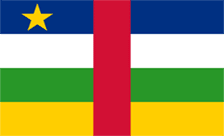
The Central African Republic (CAR), is a landlocked country in Central Africa. It borders Chad in the north, Sudan in the east, the Republic of the Congo and the Democratic Republic of the Congo in the south, and Cameroon in the west.
Most of the CAR consists of Sudano-Guinean savannas but it also includes a Sahelo-Sudanese zone in the north and an equatorial forest zone in the south. Two thirds of the country lie in the basins of the Ubangi River, which flows south into the Congo River, while the remaining third lies in the basin of the Chari River, which flows north into Lake Chad.
Since most of the territory is located in the Ubangi and Shari river basins, the French called the colony it carved out in this region Ubangi-Shari, or Oubangui-Chari in French. This French colony of Ubangi-Shari became a semi-autonomous territory of the French Community in 1958 and then an independent nation on 13 August 1960. For over three decades after independence, presidents who were not chosen in truly democratic elections or who took power by force ruled the CAR. Local discontent with this system was eventually reinforced by international pressure, following the end of the Cold War.
The first fair democratic elections were held in 1993 with resources provided by the country's donors and help from the UN Office for Electoral Affairs. They brought Ange-Félix Patassé to power, but President Patassé lost popular support and was overthrown by French-backed General François Bozizé in 2003. General Bozizé won a democratic election in May 2005 and remains in power today.
The Central African Republic is one of the poorest countries in the world and among the ten poorest countries in Africa.
In 2001 The Ecologist magazine estimated that Central African Republic is the world's leading country in sustainable development. The Central African Republic is an entirely land-locked nation within the interior of the African continent. It is bordered by the countries of Cameroon, Chad, the Sudan, the Democratic Republic of the Congo and the Republic of the Congo. Much of the country consists of flat, or rolling plateau savanna, typically about 1,640 feet (500 m) above sea level. In the northeast are the Fertit Hills, and there are scattered hills in southwest part of the country. To the northwest is the Yade Massif, a granite plateau with an altitude of 3,750 feet (1,143 m).
At 240,519 mi² (622,984 km²), the Central African Republic is the world's 43rd-largest country (after Somalia). It is comparable in size to Ukraine, and is somewhat smaller than the US state of Texas.
Much of the southern border is formed by tributaries of the Congo River, with the Mbomou River in the east merging with the Uele River to form the Ubangi River. In the west, the Sangha River flows through part of the country. The eastern border lies along the edge of the Nile river watershed.
Estimates of the amount of the country covered by forest ranges up to 8%, with the densest parts in the south. The forest is highly diverse, and includes commercially important species of Ayous, Sapelli and Sipo. The current deforestation rate is 0.4% per annum, and lumber poaching is commonplace.
The climate of the C.A.R. is generally tropical. The northern areas are subject to harmattan winds, which are hot, dry, and carry dust. The northern regions have been subject to desertification, and the northeast is desert. The remainder of the country is prone to flooding from nearby rivers. |