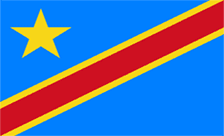
The Democratic Republic of the Congo, also often referred to as DR Congo, DRC, RDC or formerly as Congo Free State, Belgian Congo, The Congo, Congo-Léopoldville, Congo-Kinshasa, and Zaire (or Zaïre in French), is the third largest country by area on the African continent. Though it is located in the Central African UN subregion, the nation is economically and regionally affiliated with Southern Africa as a member of the Southern African Development Community (SADC). It borders the Central African Republic and Sudan on the north, Uganda, Rwanda, and Burundi on the east, Zambia and Angola on the south, the Republic of the Congo on the west, and is separated from Tanzania by Lake Tanganyika on the east. The country enjoys access to the ocean through a forty-kilometre stretch of Atlantic coastline at Muanda and the roughly nine-kilometre wide mouth of the Congo River that opens into the Gulf of Guinea. The name "Congo" (meaning "hunter") is coined after the Bakongo ethnic group who live in the Congo river basin.
Formerly the Belgian colony of the Belgian Congo, the country's post-independence name was the Republic of the Congo until August 1, 1964, when its name was changed to Democratic Republic of the Congo (to distinguish it from the neighboring Republic of the Congo). On October 27, 1971, then-President Mobutu renamed the country Zaire, from a Portuguese mispronunciation of the Kikongo word nzere or nzadi, which translates to "the river that swallows all rivers." Following the First Congo War which led to the overthrow of Mobutu in 1997, the country was renamed Democratic Republic of the Congo. From 1998 to 2003, the country suffered greatly from the devastating Second Congo War (sometimes referred to as the African World War), the world's deadliest conflict since World War II. However, related fighting still continues in the east of the country. The Congo is situated at the heart of the west-central portion of sub-Saharan Africa and is bounded by (clockwise from the southwest) Angola, the Republic of Congo, the Central African Republic, the Sudan, Uganda, Rwanda, Burundi, Tanzania across Lake Tanganyika, and Zambia. The country straddles the Equator, with one-third to the north and two-thirds to the south. The size of Congo, 2,345,408 square kilometers (905,567 sq mi), is comparable to that of Western Europe.
As a result of its equatorial location, the Congo experiences large amounts of precipitation and has the highest frequency of thunderstorms on Earth. The annual rainfall can total upwards of 80 inches (200 cm) in some places, and the area sustains the second largest rain forest in the world (after the Amazon). This massive expanse of lush jungle covers most of the vast, low-lying central basin of the river, which slopes toward the Atlantic Ocean in the west. This area is surrounded by plateaus merging into savannas in the south and southwest, by mountainous terraces in the west, and dense grasslands extending beyond the Congo River in the north. High, glaciated mountains are found in the extreme eastern region.
The tropical climate has also produced the Congo River system which dominates the region topographically along with the rainforest it flows through, (though they are not mutually exclusive). The name for the "Congo" state is derived from that of the river, along with that of the Kongo Empire, which controlled much of the region in precolonial times. The river basin (meaning the Congo River and all of its myriad tributaries) occupy nearly the entire country and an area of nearly one million square kilometers (400,000 sq mi). The river and its tributaries (major offshoots include the Kasai, Sangha, Ubangi, Aruwimi, and Lulonga) form the backbone of Congolese economics and transportation, they have a drastic impact on the daily lives of the people. The sources of the Congo are in the highlands and mountains of the East African Rift, as well as Lake Tanganyika and Lake Mweru. The river flows generally west from Kisangani just below Boyoma Falls, then gradually bends southwest, passing by Mbandaka, joining with the Ubangi River, and running into the Pool Malebo (Stanley Pool). Kinshasa and Brazzaville are actually on opposite sides of the river at the Pool, then the river narrows and falls through a number of cataracts in deep canyons (collectively known as the Livingstone Falls), and then running past Boma into the Atlantic Ocean. The river also has the second-largest flow and the second-largest watershed of any river in the world (trailing the Amazon in both respects). The river and a forty-kilometre-wide strip of land on its north bank provide the country's only outlet to the Atlantic; otherwise it would be completely landlocked.
The previously mentioned Great Rift Valley, in particular the Eastern Rift, plays a key role in shaping the Congo's geography. Not only is the northeastern section of the country much more mountainous, but due the rift's tectonic activities, this area also experiences low levels of volcanic activity. The rifting of the African continent in this area has also manifested itself as the famous Great Lakes, three of which lie on the Congo's eastern frontier: Lake Albert (known previously as Lake Mobutu), Lake Edward, and Lake Tanganyika. Perhaps most important of all, the Rift Valley has exposed an enormous amount of mineral wealth throughout the south and east of the Congo, making it accessible to mining. Cobalt, copper, cadmium, industrial and gem-quality diamonds, gold, silver, zinc, manganese, tin, germanium, uranium, radium, bauxite, iron ore, and coal are all found in plentiful supply, especially in the Congo's southeastern Katanga region.
On January 17, 2002 Mount Nyiragongo erupted in Congo, with the lava running out at 40 mph (60 km/h) and 50 yards (50 m) wide. One of the three streams of lava emitted flowed through the nearby city of Goma, killing 45 and leaving 120,000 homeless. 400,000 people were evacuated from the city during the eruption. The lava poisoned the water of Lake Kivu, killing fish. Only two planes left the local airport because of the possibility of the explosion of stored petrol. The lava passed the airport but ruined the runway, entrapping several airplanes. Six months after the 2002 eruption, nearby Mount Nyamuragira also erupted, and again more recently in 2006. Both volcanoes remain active.
|