
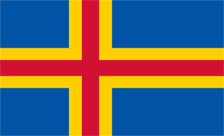
The Aland Islands form an archipelago in the Baltic Sea. It is situated at the entrance to the Gulf of Bothnia and forms an autonomous, demilitarized, monolingually Swedish-speaking administrative province, region and historical province of Finland. It is the smallest province of Finland, comprising 0.50% of Finland's population and 0.49% of land area.
The islands consist of the main island Fasta Aland (where 90% of the population resides) and an archipelago to the east that consists of over 6,500 skerries and islands. Fasta Aland is separated from the coast of Sweden by forty kilometers (twenty-five miles) of open water to the west. In the east, the Aland archipelago is virtually contiguous with the Finnish Archipelago Sea. Aland's only land border is short and strangely shaped; it is located on the uninhabited island of Market, which it shares with Sweden. That border was re-negotiated in 1985.
Due to Aland's autonomous status, the powers exercised at the provincial level by representatives of the central state administration in the rest of Finland are largely exercised by the Government of Aland in Aland. The Aland Islands occupy a position of great strategic importance, as they command one of the entrances to the port of Stockholm, as well as the approaches to the Gulf of Bothnia, in addition to being situated near the Gulf of Finland.
The Aland archipelago consists of nearly three hundred habitable islands, of which about eighty are inhabited; the remainder are merely some 6,000 skerries and desolate rocks. The archipelago is connected to Aboland archipelago in the east, the archipelago adjacent to the southwest coast of Finland. Together they form the Archipelago Sea.
The surface of the islands is generally rocky, the soil thin, and the climate keen. There are several excellent harbors.
The islands' landmass occupies a total area of 1,512 square kilometers (583 sq. mi). Ninety per cent of the population live on Fasta Aland (the Main Island), also the site of the capital town of Mariehamn. Fasta Aland is the largest island in the archipelago, extending over 1,010 square kilometers, more than 70% of the province's land area, and stretching 50 kilometers (31 mi) from north to south and 45 kilometers (28 mi) from east to west.
During the Aland Crisis, the parties sought support from different maps of the islands. On the Swedish map, the most densely populated main island dominated, and many skerries were left out. On the Finnish map, a lot of smaller islands or skerries were, for technical reasons, given a slightly exaggerated size. The Swedish map made the islands appear to be closer to the mainland of Sweden than to Finland; the Finnish map stressed the continuity of the archipelago between the main island and mainland Finland, while a greater gap appeared between the islands and the archipelago on the Swedish side. Although both Finns and Swedes of course argued for their respective interpretations, in retrospect it is hard to say that one is more correct than the other. One consequence is the oft-repeated number of "over 6,000" skerries that was given authority by the outcome of the arbitration. |